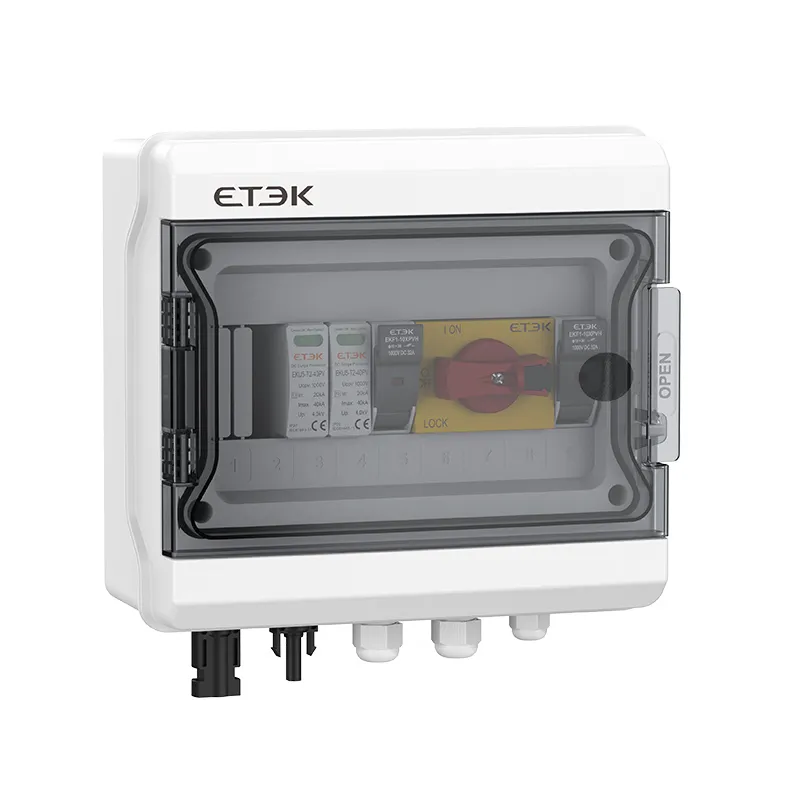
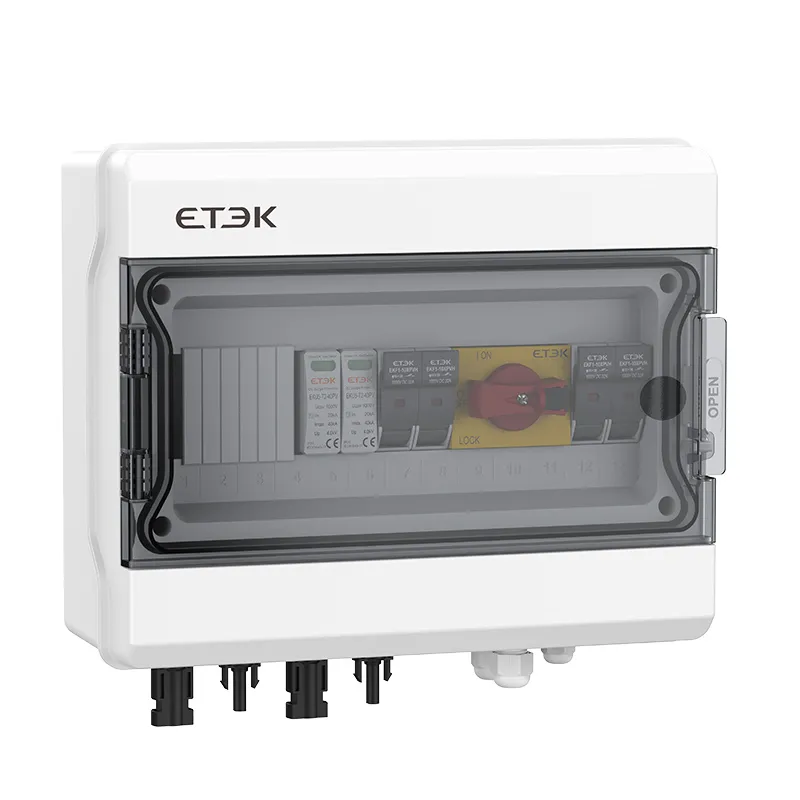
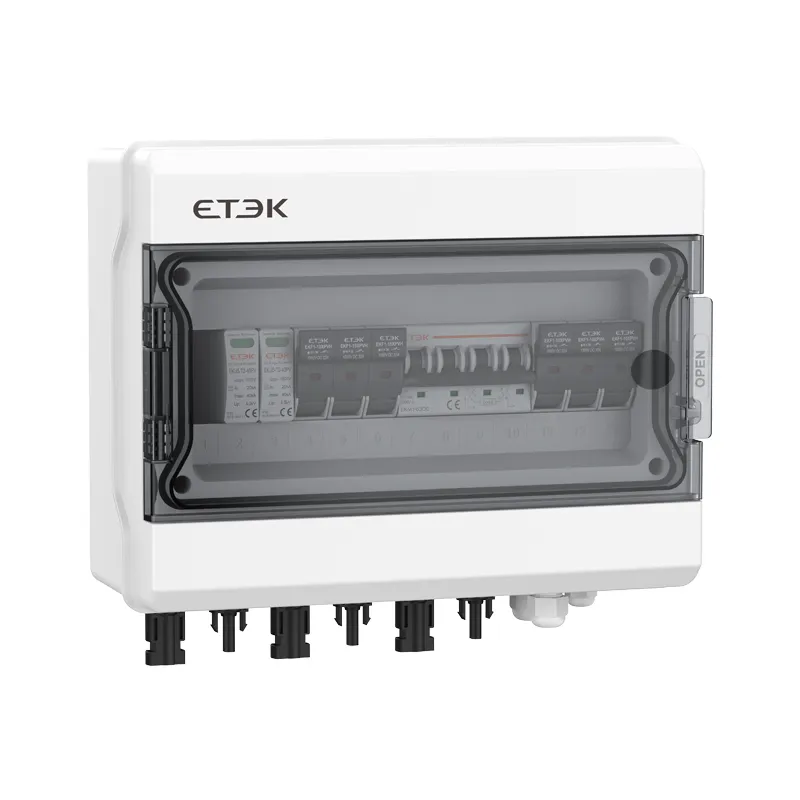
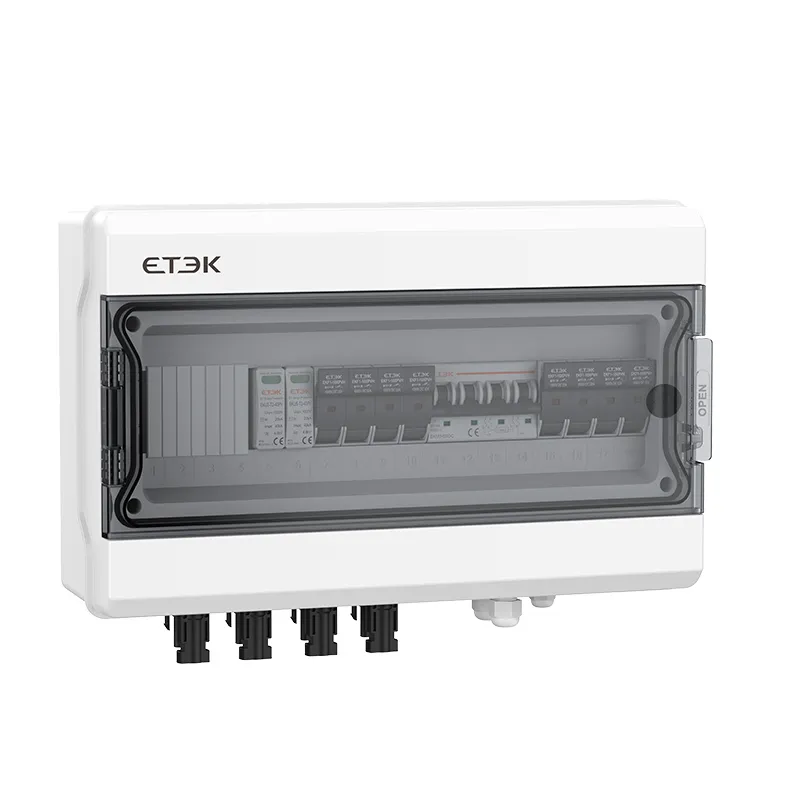
A commercial solar installer kept receiving service calls for a 600VDC‑rated miniature breaker tripping on a three‑string combiner box. The string voltage was 500V DC, well below the 600V rating. The breaker tripped only when all three strings were producing peak power. The manufacturer eventually explained that the 600V rating assumed a single string. For a breaker connected in a series string with multiple sources, the voltage across the open contacts was the sum of the string voltages, not the rating of a single pole.
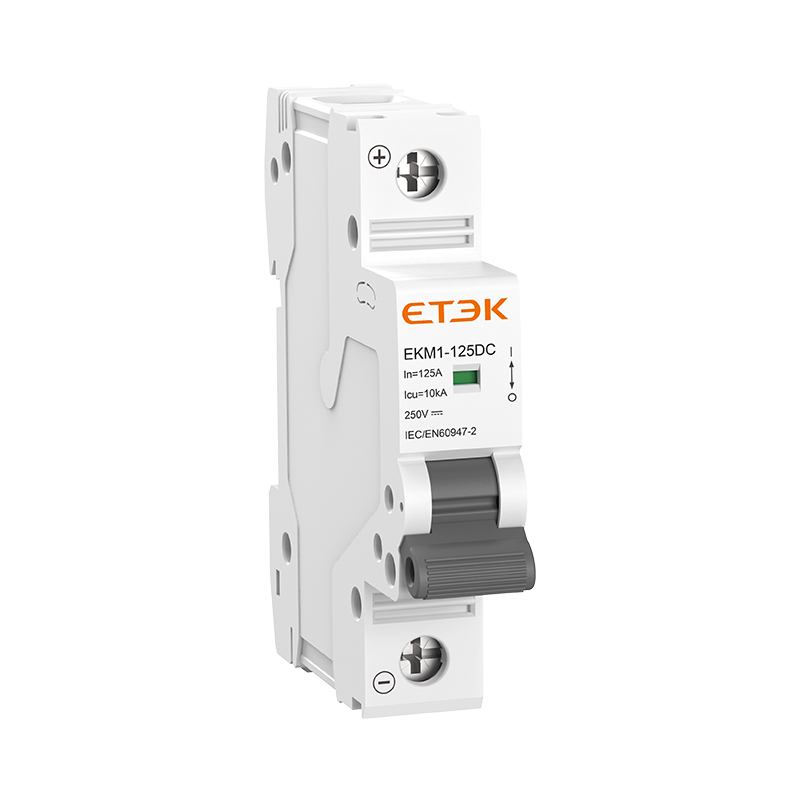
The correction came from the EKM1‑125DC, a 4‑pole unit that opens all poles simultaneously. The 1000V DC rating accounts for the series‑connected string combination.
A circuit breakers system designed for photovoltaic circuits must account for the voltage at which the DC arc can sustain itself. Unlike AC, which crosses zero every half‑cycle, DC current is continuous. An arc that forms when a DC breaker opens will not self‑extinguish. The EKM1‑125DC uses a special arc extinguishing system to elongate and cool the arc before it can damage the contacts. The 6kA breaking capacity ensures that even a full short‑circuit from a 100kW solar array will be interrupted before the inverter is damaged.
This article explains why breaker voltage de‑rating in a series string is more complex than looking at a single pole, how the thermal‑magnetic trip curve protects the inverter from both overcurrents and short‑circuits, and where the 6kA breaking capacity fits in a 100kW commercial solar array.
Poly‑wire, bi‑wire, and tri‑wire configurations: why does a 1‑pole, 2‑pole, or 4‑pole breaker change the maximum string voltage?
The EKM1‑125DC series circuit breakers are offered in 1‑pole, 2‑pole, and 4‑pole configurations, each with a different voltage rating:
-
1‑pole (1P): 250V DC
-
2‑pole (2P): 500V DC
-
4‑pole (4P): 1000V DC
When a breaker is listed as “4‑pole, 1000V DC,” the rating applies to the complete circuit where all four poles are connected in series and opened simultaneously. A 2‑pole breaker can be used for a single string of panels up to 500V; a 4‑pole unit is required for a 1000V string. Using a 2‑pole breaker in a series string where the potential between line and neutral is 1000V DC will cause the breaker to arc across the air gap of the open poles, leading to a fire. For a 1000V DC combiner box that combines three strings of panels (each 500V DC), the wiring between the common bus and the inverter sees the sum of the voltages, and a 1000V DC 4‑pole breaker is required.
The 125A current rating covers the full output of a 100kW commercial solar array at 1000V DC (I = P/V). A string of 300W panels at 1000V DC might produce 40‑50A; the EKM1‑125DC has sufficient headroom.
Thermal‑magnetic trip: why does a 100A breaker need two independent mechanisms to protect a solar inverter from a 500A inrush?
A circuit breakers that only uses a thermal bimetal strip will be too slow to protect electronics from a dead short. A short‑circuit current can rise to thousands of amps in microseconds; a thermal trip might take tens of milliseconds.
The EKM1‑125DC uses a thermal‑magnetic trip, where the thermal element handles sustained overcurrents and the magnetic element handles short‑circuits [0†L27-L29]. For a 100A breaker:
-
The thermal element trips when the current exceeds 100A for a period determined by the bimetal heating curve.
-
The magnetic element trips instantaneously when the current exceeds approximately 8‑12 times the rated current (800‑1200A for a 100A breaker). The exact setting depends on the tripping curve (B, C, or K)
| Trip Type | Response | Protects Against |
|---|---|---|
| Thermal (bimetal) | 0.5 – 20 seconds, inverse time | Sustained overload (cable heating) |
| Magnetic (solenoid) | <10 milliseconds | Short‑circuit (inverter input capacitors) |
| Combined | Overlaps in the 8‑12x In range | Full range |
In a solar array, a faulty combiner box might draw 150A (a 50% overload) for 5 seconds before the thermal trip opens. A dead short from a panel junction box will pull 6,000A (60x rated current), and the magnetic trip will clear the fault in under 10 milliseconds, preventing the inverter from seeing the surge.
Non‑polarity vs. polarity design: why does a PV combiner that sources current both ways need a breaker that does not care which terminal is line and which is load?
A conventional DC breaker is polarity‑sensitive. Current must flow from the line side (input) to the load side (output). If the current tries to flow backwards, the electromagnetic blowout coil in the breaker may not function, and the arc will not be extinguished.
In a PV system, a battery inverter can feed current back into the array. An EV charger with vehicle‑to‑grid (V2G) capability can send power from the car battery back to the combiner box. In both cases, the current direction through the breaker reverses.
The EKM1‑125DC is a non‑polarity design. The internal arc‑extinguishing mechanism works regardless of whether the terminal on the left or the right is the line side. The arc is drawn away from the contacts by a permanent magnet, and the blowout path does not depend on the sign of the current.
For a bidirectional battery storage system connected to a solar array via a common bus, a non‑polarity breaker is required. A polarity‑sensitive breaker in that location would fail to interrupt a fault when the battery discharges into a shorted string.
6kA breaking capacity: what happens to a 4‑pole breaker when the short‑circuit current is 10,000A at 1000V DC?
The rated short‑circuit breaking capacity (Icn) of the EKM1‑125DC is 6,000A (6kA) at its rated voltage [0†L29]. If the prospective short‑circuit current of the installation exceeds 6kA, the breaker may not clear the fault and could explode.
A 100kW solar array at full sun can deliver a short‑circuit current 2‑5 times its rated output (2,000‑5,000A). If the array is fed from a large battery bank, the short‑circuit current can be 20,000A. The upstream breaker must be selected with a breaking capacity higher than the available fault current.
A circuit breakers that is used in a system with a high fault current must be rated for at least the available fault current. The EKM1‑125DC’s 6kA rating suits a typical commercial PV array with a transformer‑based inverter. For a system with battery storage or multiple inverters in parallel, a higher‑rated breaker (such as a 15kA AC breaker from the ETM1‑63UH series) is required on the inverter’s AC side.
IP20, DIN rail, and ambient temperature: why does a combiner box in a desert environment need a different breaker than a combiner box in a freezer?
The EKM1‑125DC is specified for an ambient temperature range of -5°C to +40°C, with a maximum humidity of 95% [5†L29-L30]. The IP20 protection rating (dust‑proof only, not waterproof) means the breaker must be installed inside an enclosure that provides additional mechanical protection. For an outdoor combiner box in a hot climate, the enclosure must be ventilated and shaded so the internal temperature does not exceed 40°C. For a freezer room (‑10°C), the breaker’s tripping curve may shift, and the magnetic instantaneous trip may operate at a lower current due to the colder bimetal strip.
The DIN rail mounting (35mm standard rail) allows the breaker to be snapped onto the rail without screws, which speeds up combiner box assembly and simplifies replacement. The terminal accepts up to 25mm² cable, which is sufficient for 125A copper conductors (approximately 35mm²).
Dielectric strength requires a test voltage of 3kV at industrial frequency for 1 minute to pass insulation integrity test for the 1000V DC rating .
How the EKM1‑125DC fits into a commercial solar combiner box
ETEK Electric (Zhejiang ETEK Electrical Technology Co., Ltd.) has manufactured DC circuit protection devices for photovoltaic systems since 2011. The company operates a 40,000 sqm facility in Wenzhou and Wuhu with over 500 employees, including more than 50 R&D engineers, and holds ISO 9001, ISO 14001, ISO 45001 certifications, with product certifications including CB, TUV, VDE, CE, and RoHS. The “ETEK” brand is registered in over 80 countries and serves more than 100 international markets.
The EKM1‑125DC DC miniature circuit breaker is designed for commercial and utility‑scale solar arrays up to 125A at 1000V DC, rated short‑circuit breaking capacity of 6kA, thermal‑magnetic trip curve (B, C, or K), 1‑pole, 2‑pole, and 4‑pole configurations, and non‑polarity design for bidirectional protection. It is supplied with a CE certificate and complies with IEC60947‑2.
For a circuit breakers that eliminates nuisance trips in 1000V DC solar strings and protects the inverter from both overloads and short‑circuits, the EKM1‑125DC delivers a 6kA breaking capacity, thermal‑magnetic trip, selectable pole configuration, non‑polarity operation, and IP20 DIN rail mounting.
【Request a quote from ETEK Electric】
Send ETEK your array string voltage (up to 1000V DC), maximum string current (up to 125A), and combiner box pole count to receive an EKM1‑125DC configuration recommendation with a full test report package.
-1640.jpg)
 - Enterprise-Protection-Solution-1052.webp)