You’ve seen those combiner boxes where someone wrote “LINE” and “LOAD” in permanent marker, just in case. Or maybe you’ve gotten that late-night call from a site: “The breaker tripped, but we’re not sure which side is positive.” Sound familiar? The truth is, DC mini circuit breaker selection doesn’t have to be a puzzle. Some designs are genuinely straightforward—no polarity headaches, no arc extinction guesswork, no voltage math that makes your head spin. In this guide, we’ll strip away the complexity and show you exactly what makes a DC breaker simple to specify, simple to install, and simple to trust. You’ll learn why non-polarity alone saves hours of troubleshooting, how to match curves to your loads without memorizing tables, and what to check in under two minutes before closing the panel.
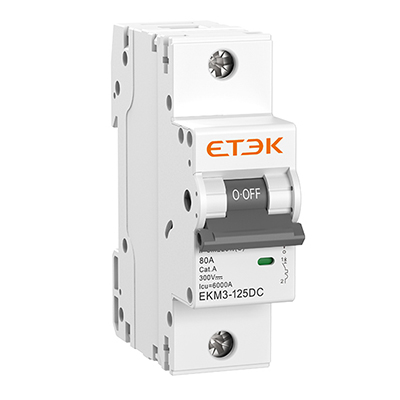
The one feature that removes half your installation steps
Let’s talk about the biggest time-waster in DC protection: polarity. With a standard polarized breaker, you must connect the positive supply to the correct terminal. If you reverse it, the internal arc chamber won’t work. When a fault happens, the arc may not extinguish, and you could have a failure.
A non-polarity breaker solves that entirely. You don’t need to trace wires back to confirm orientation. You don’t need to mark terminals. You don’t need to worry about reverse current from mismatched strings. The breaker protects equally well regardless of current direction. That’s it. One feature cuts installation time, eliminates a whole class of callbacks, and makes future service simpler because any technician can land the wires correctly without a diagram.
Think about a typical rooftop job. You’re working under the sun, maybe wearing gloves, trying to read tiny terminal markings. A non-polarity breaker removes that friction. You land the wires, torque the screws, and move on.
How thermal-magnetic works without you thinking about it
Inside the breaker are two separate mechanisms. The thermal side uses a bimetallic strip that bends with sustained overcurrent—slow overloads from a failing component or excessive string current. The magnetic side handles short circuits with a coil that instantly pulls the contacts open. For DC, the critical part is arc extinction. DC arcs don’t naturally stop like AC arcs (which cross zero 100 times per second). So the breaker uses arc chutes—stacked metal plates—to split, stretch, and cool the arc until it dies.
What does that mean for you? When a breaker is truly rated for DC, it has those arc chutes and appropriate contact materials. When it’s not—like using an AC-only breaker—the arc can persist, weld the contacts, and the breaker becomes a conductor. That’s why the simplest rule is: always use a DC-rated breaker for DC circuits. Non-polarity DC breakers add an extra layer of simplicity because there’s no “wrong way” to wire them.
Sizing without second-guessing
Getting the current rating right seems easy. But there are three factors you can’t ignore.
Ambient temperature. Breakers are calibrated at 30°C. Inside a solar combiner box on a summer day, temperatures often hit 50–60°C. Heat shifts the thermal trip curve. A breaker that should carry 50A may trip at 45A in a hot box. The practical fix: either choose the next higher rating (e.g., 63A instead of 50A) or consult the manufacturer’s derating table.
Load type. Inverters and charge controllers have input capacitors that draw a surge when first powered up. A B-curve breaker (trips at 3–5x rated) may nuisance-trip. C-curve (5–10x) handles most solar loads. K-curve (10–14x) is for large battery banks or transformers. Match the curve to your load.
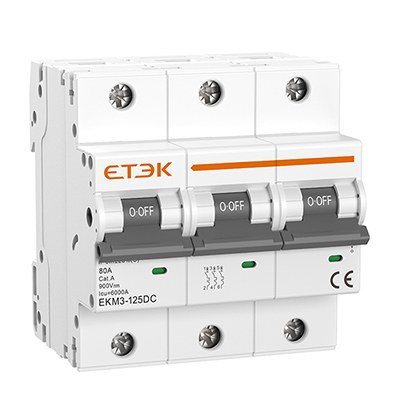
Voltage rating. A single pole on the EKM3-125DC is rated for 300V DC. Need 600V? Use two poles in series. Need 1200V? Use four poles. It’s additive. Check your system’s maximum voltage and ensure the breaker’s total series rating meets or exceeds it.
Below is a quick reference for common PV system voltages and the minimum pole configuration:
| System DC Voltage | Minimum Poles | Common Application |
|---|---|---|
| 12V – 48V | 1P | Small off-grid, RVs, boats |
| 100V – 300V | 1P | Residential string inverters |
| 400V – 600V | 2P | Commercial rooftop arrays |
| 700V – 900V | 3P | Large commercial PV, storage |
| 1000V – 1200V | 4P | Utility-scale solar, high-voltage BESS |
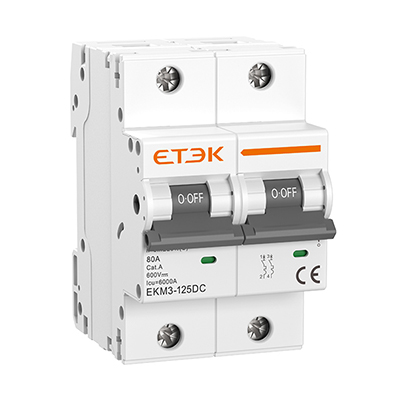
Why 6kA breaking capacity matters more than you think
Breaking capacity is the maximum fault current the breaker can interrupt without self-destructing. The EKM3-125DC is rated for 6kA at its rated voltage. That’s enough for many residential and commercial installations. But you need to do one simple calculation: the prospective short-circuit current at the combiner box.
Imagine your array has a potential fault current of 5kA. A 6kA breaker gives you a safe margin. But if your fault current is 7kA, that breaker won’t clear the fault reliably. The contacts could weld, or worse, the breaker could explode. For larger systems, you may need a breaker with 10kA, 15kA, or higher. Always check your string configuration and inverter specifications. If you’re unsure, ask an electrical engineer. It takes ten minutes to calculate and might save a fire.
Common questions that come up on site
Q: Can I save money by using a regular AC mini breaker for my solar DC circuits?
A: You could, but it’s a gamble. AC breakers lack the arc extinction needed for DC. A DC fault arc doesn’t go out on its own. The breaker may fail to trip, or the contacts may weld closed. Always use a breaker specifically rated for DC—and for simplicity, a non-polarity one.
Q: What’s the difference between B, C, and K curves in real-world DC use?
A: B curve trips quickly (3–5x) for purely resistive loads like heaters. C curve (5–10x) is the standard for inverters and pumps—most solar applications. K curve (10–14x) handles high inrush from large battery banks or transformers. The EKM3-125DC is available in all three.
Q: How do I protect a battery that both charges and discharges?
A: Use a non-polarity breaker. Current flows in both directions. A polarized breaker only protects one direction. Non-polarity protects both, which is why it’s the simple choice for energy storage systems.
What ETEK Electric did to make DC protection boring (in a good way)
Boring is good when it comes to circuit protection. You want a breaker that you install and then forget about. That’s the idea behind the EKM3-125DC Non-Polarity High-Current DC Miniature Circuit Breaker (Up to 125A) from ETEK Electric.
Non-polarity construction means you can’t wire it wrong. Thermal-magnetic protection handles both slow overloads and fast shorts. The 6kA breaking capacity meets IEC 60947-2 standards. Available current ratings: 80A, 100A, 125A. Pole configurations from 1P (300V) to 4P (1200V). Choose B, C, or K curves to match your load. Mounts on standard 35mm DIN rail. Terminal torque values are printed right on the housing. The wiring diagram is simple enough that you don’t need to flip through a manual.
ETEK Electric started in 2011 in Wenzhou, China, and runs a 40,000-square-meter facility focused on new energy and low-voltage electrical products. Their goal is straightforward: make green energy safer and more reliable with equipment that doesn’t overcomplicate things.
Before you finish your next installation, run this two-minute checklist:
-
Voltage – Does the breaker’s total series voltage rating meet or exceed your system max?
-
Current – Is the rating at least 125% of your continuous load (NEC 240.6)?
-
Interrupt capacity – Does 6kA cover your available fault current?
-
Polarity – Non-polarity? Good. No worry.
-
Curve – Is it B, C, or K for your load type?
-
Mounting – Fully clicked onto the DIN rail?
-
Torque – Terminals tightened to spec (printed on device)?
-
Label – Circuit identified on panel schedule?
Get these right, and the breaker will do its job silently. No drama. No callbacks.
Need a simpler way to protect your solar DC circuits? Contact ETEK Electric for a quote on the EKM3-125DC non-polarity DC miniature circuit breaker. Tell them your system voltage, current, and load type—they’ll help you select the right pole configuration and tripping curve.
-1640.jpg)