You’ve seen it before. An EV charger trips, and you’re not sure why. Was it a leakage fault? An overload? A short circuit? On older installations, you’d need two separate devices — an RCCB for earth leakage and an MCB for overcurrent — and you’d have to check both to find the cause.
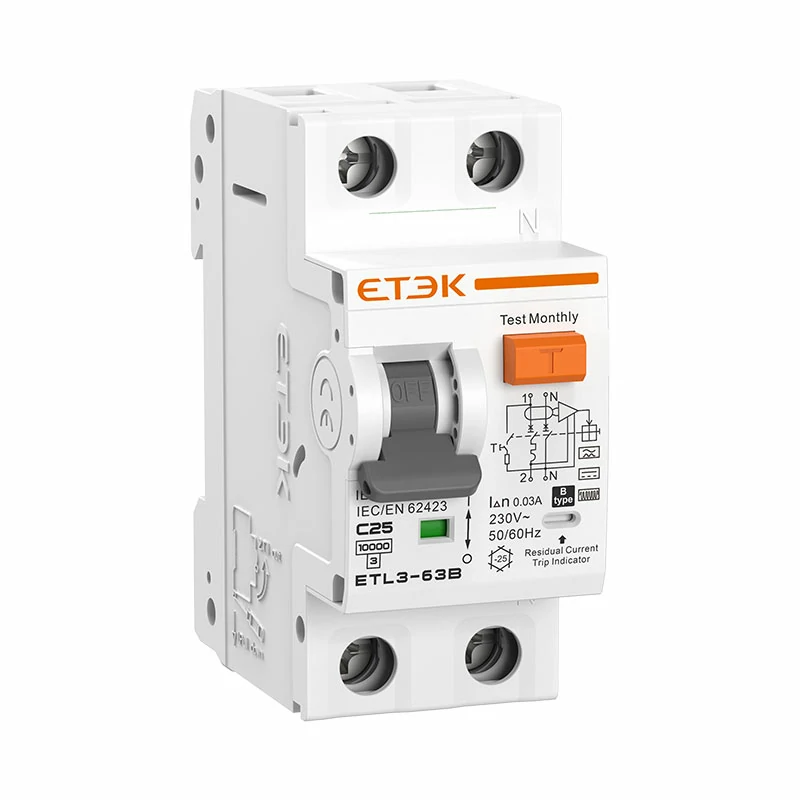
A breaker with overcurrent protection — commonly known as an RCBO — changes that. It integrates both functions into a single, compact device. But where does it actually get used? The answer is: wherever modern electrical loads generate the kinds of fault currents that older protection devices can’t handle. Type B RCBOs are specifically designed for the applications that define today’s electrical landscape — EV chargers, solar PV, heat pumps, and more. This guide covers where a breaker with overcurrent protection is used most, and why Type B is the only choice for these applications.
EV charging stations — where Type B is required
Electric vehicle chargers are one of the fastest-growing applications for breakers with overcurrent protection. They’re also one of the most demanding.
Why EV chargers need Type B protection
EV chargers contain rectifiers and power conversion electronics that generate smooth DC residual currents and high‑frequency AC currents. Standard Type AC and Type A RCDs may not detect these fault currents, leaving the system unprotected. A Type B RCBO detects AC, pulsating DC, smooth DC, and high‑frequency residual currents up to 1kHz — covering the full range of fault types that EV chargers produce.
Where you’ll find them
In many countries, Type B RCDs are now required by electrical code for EV charging installations. Public charging stations, workplace chargers, and residential EV wallboxes all need this level of protection. With up to 63A rating and 10kA breaking capacity, Type B RCBOs handle the current demands of both single‑phase and three‑phase EV chargers.
The practical benefit
For facility managers and installers, a Type B RCBO means fewer nuisance trips, better protection for expensive charging equipment, and compliance with current regulations — all in a single module width.
Solar PV systems — protecting the inverter and the array
Solar photovoltaic systems are another major application for breakers with overcurrent protection. The inverter is the critical component, and it generates the same kinds of DC fault currents that EV chargers do.
What solar PV generates
Solar inverters convert DC from the panels to AC for the grid or building. During normal operation, they produce smooth DC residual currents that standard RCDs miss. When a fault occurs, the inverter may also generate high‑frequency currents that Type AC and Type A devices can’t detect.
Where they’re installed
Type B RCBOs are especially suited for solar panel installations. They’re typically installed in the AC distribution board on the building side of the inverter, providing protection for the circuit between the inverter and the main panel. For larger commercial solar installations, multiple RCBOs may be used to protect individual strings or sub‑panels.
Why it matters
Without Type B protection, a leakage fault in a solar system could go undetected until it causes equipment damage or creates a safety hazard. The 30mA sensitivity trips within 0.1 seconds — fast enough to protect both equipment and people.
Heat pumps and VFDs — modern loads, modern protection
Heat pumps and variable frequency drives are becoming increasingly common in residential, commercial, and industrial settings. Both generate the same complex fault currents as EV chargers and solar inverters.
Why they need RCBO protection
Heat pumps contain compressors and electronics that create pulsating DC and high‑frequency currents. VFDs — used to control motor speed in HVAC, pumps, and conveyor systems — also generate smooth DC components during rectification. Standard RCDs can’t detect these fault currents, leaving the equipment and the circuit unprotected.
Where they’re found
Residential heat pump installations, commercial HVAC systems, and industrial motor control panels all benefit from Type B RCBO protection. Bi‑directional wiring capability simplifies installation in retrofit applications where panel wiring is already in place.
Industrial and commercial panels — comprehensive protection in one module
Beyond specific applications like EV charging and solar, breakers with overcurrent protection are widely used in industrial and commercial distribution panels.
What they protect
In factories, office buildings, and public facilities, RCBOs protect individual circuits against earth leakage, overload, and short circuit. They’re used for socket outlets, lighting circuits, and equipment feeds where both leakage and overcurrent protection are required.
Why they’re chosen
A 1P+N RCBO occupies a single module width (18mm), replacing two separate devices that would require 2–4 modules. For panel designers, that’s a significant space saving. For maintenance teams, it means fewer terminals to check and less time tracing faults. Visual indicators — red/green for contact position, white/blue for fault status — make troubleshooting faster.
Below is a quick reference for where Type B RCBOs are used:
| Application | Why Type B Is Needed | Typical Installation Location |
|---|---|---|
| EV chargers | Smooth DC residual currents | AC distribution panel upstream of charger |
| Solar PV systems | DC leakage from inverter | Building-side panel after inverter |
| Heat pumps | Pulsating DC from electronics | HVAC sub‑panel or main panel |
| VFDs / motor drives | Smooth DC and high‑frequency currents | Motor control panel |
| General industrial circuits | Comprehensive protection in one module | Factory distribution boards |
Questions about RCBO applications
Q: Can I use a standard RCCB for EV charger protection?
A: No. Standard Type AC RCCBs only detect AC leakage. Type A devices add pulsating DC detection but miss smooth DC and high‑frequency currents. Type B RCBOs detect AC, pulsating DC, smooth DC, and high‑frequency residual currents — the full range of fault types that EV chargers produce.
Q: What current rating do I need for a solar PV circuit?
A: Type B RCBOs are available in rated currents from 6A to 63A. Choose a rating that matches the circuit you’re protecting — typically the inverter’s AC output current plus a margin. For residential solar, 16–32A is common. For commercial installations, you may need up to 63A.
Q: Can a Type B RCBO be used in existing panels without rewiring?
A: Yes. Many Type B RCBOs support bi‑directional wiring, meaning they can be installed in either direction without affecting performance. In retrofit applications where panel wiring is already in place, this simplifies installation and reduces the risk of polarity errors.
The ETL3‑63B — built for the job
The ETL3‑63B Type B RCBO is designed specifically for the applications described above. It’s certified to IEC 61009-1 and IEC 62423, with a 10kA breaking capacity, 30mA sensitivity, and detection of AC, pulsating DC, smooth DC, and high‑frequency residual currents.
The device is rated for operation from -25°C to +55°C with IP20 protection, making it suitable for indoor installations in a range of environments. It offers bi‑directional wiring for flexible installation, visual indicators for quick status checks, and energy‑limiting class 3 to minimize damage during faults. Available in rated currents from 6A to 63A with B and C tripping curves, it covers the range of modern electrical loads.
Before you specify protection for your next installation, identify the applications on your circuit. If you have EV chargers, solar inverters, heat pumps, or VFDs, Type B is the only choice that covers all fault types. The ETL3‑63B delivers that coverage in a compact, easy‑to‑install package.
Ready to specify the right RCBO for your application? Contact ETEK Electric for samples or technical support. Share your load type, rated current, and tripping curve preference — their team can confirm the right ETL3‑63B configuration for your specific requirements.
-1640.jpg)
 - Enterprise-Protection-Solution-1052.webp)