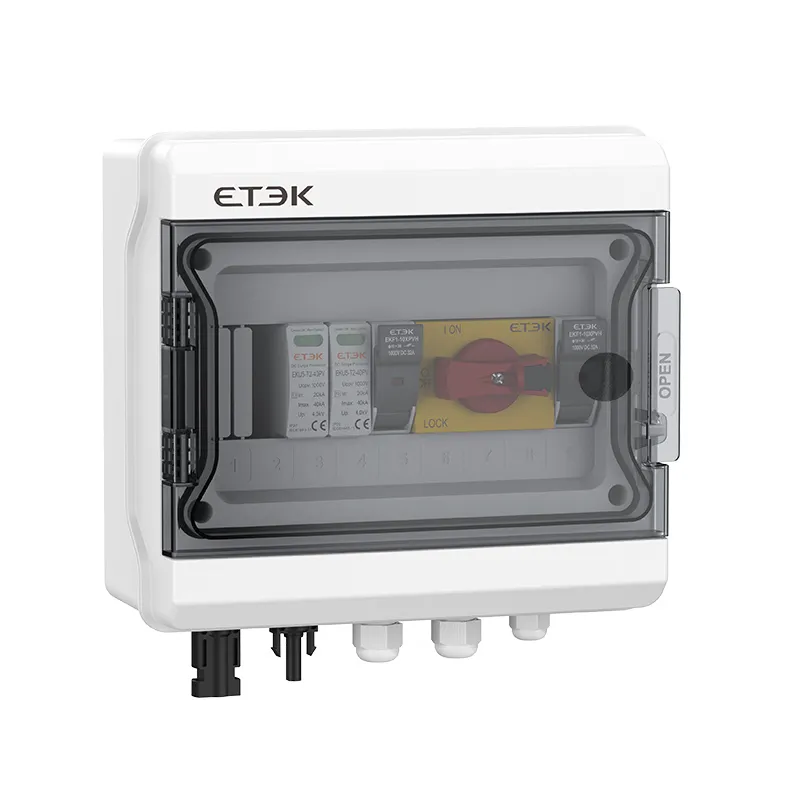
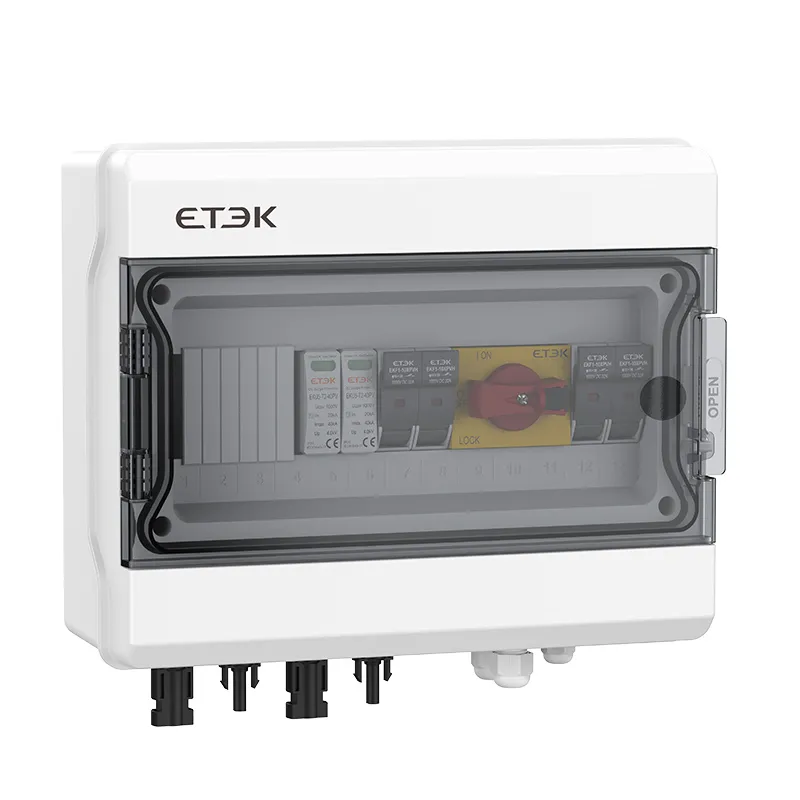
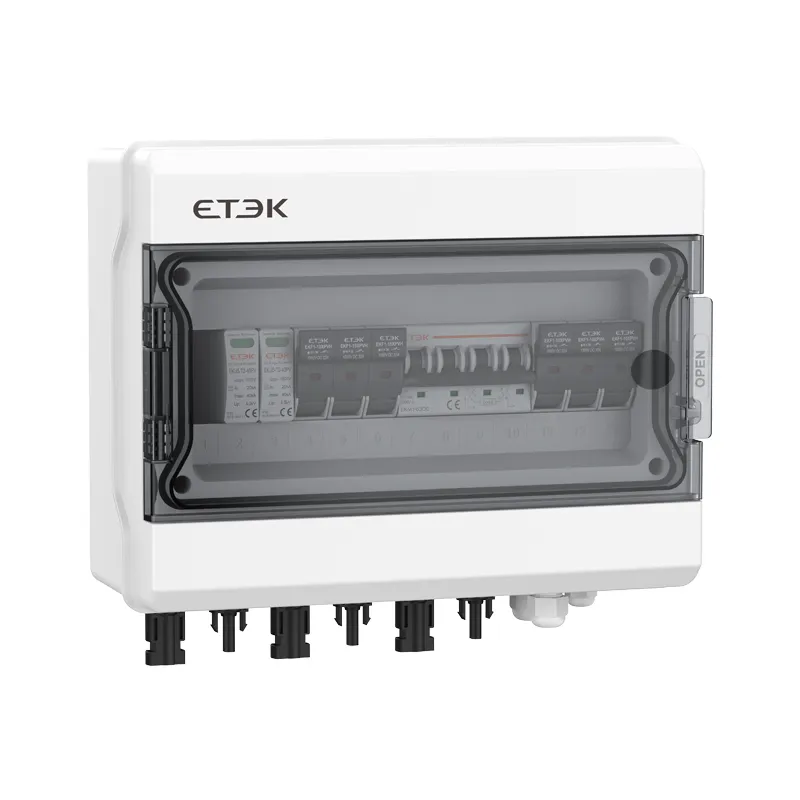
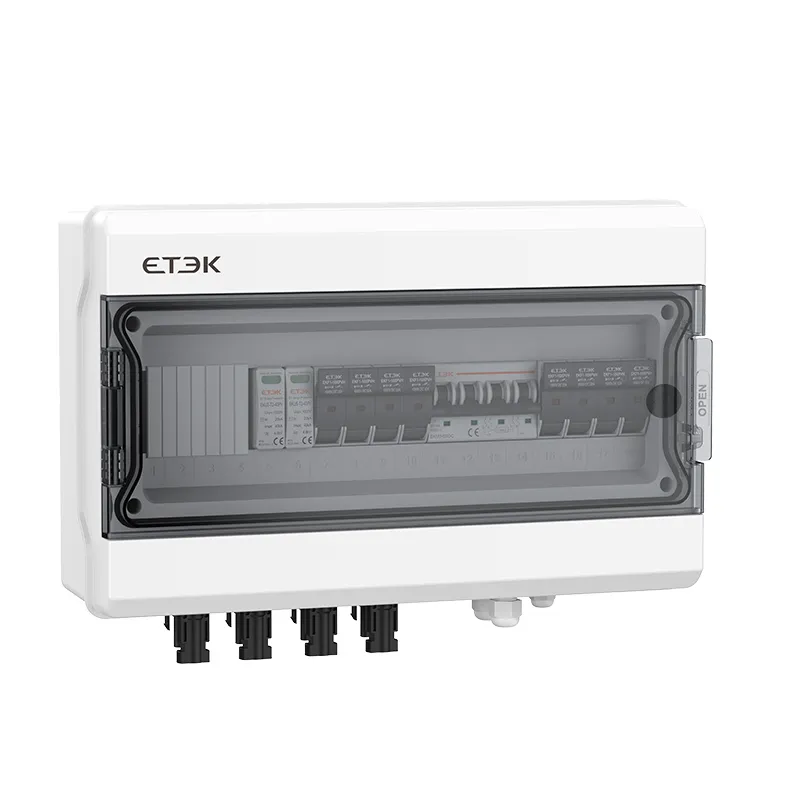
A solar array spreads across a field or a rooftop. Strings of panels feed DC power into combiner boxes, which then route current to inverters. A lightning strike nearby doesn't have to hit the array directly to damage it. The electromagnetic pulse from a strike tens of meters away induces a voltage surge on the long DC cables. That surge travels into the combiner box, passes through the inverter, and can destroy the control board or the power semiconductors.
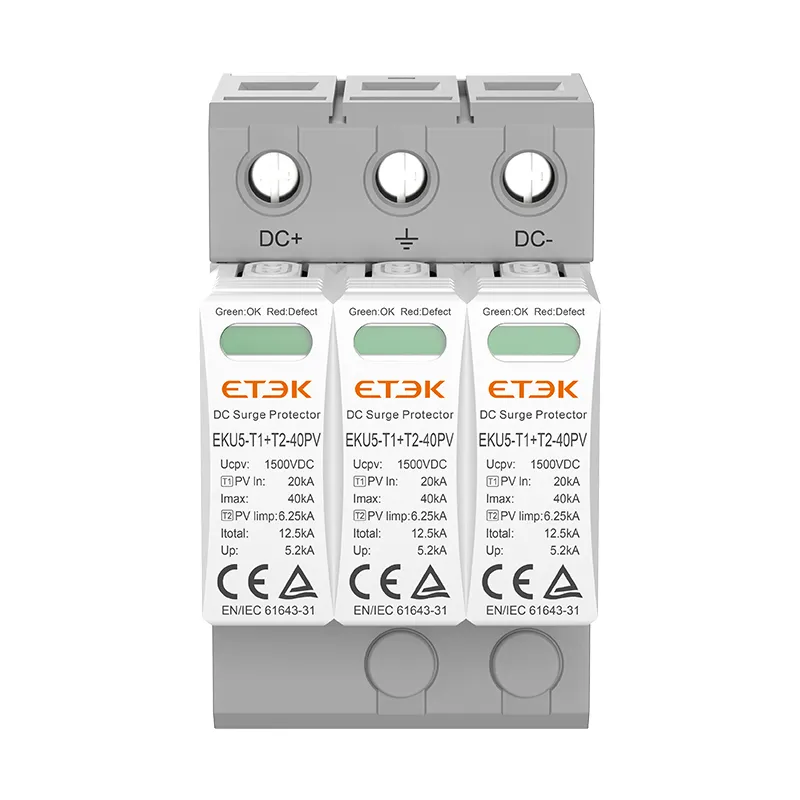
That is why a surge protection devices system rated for both direct and indirect strikes is installed at the DC input of every combiner box. The Type 1+2 Combined Protection | 40kA DC SPD | 1500V Solar PV Surge Arrester from ETEK Solar is a four‑pole device that connects between the DC positive and negative conductors and ground. When the voltage across its terminals rises above its clamping threshold, the internal metal oxide varistors (MOVs) and gas discharge tubes conduct the surge current to ground, limiting the voltage seen by the downstream equipment. The device is rated for a maximum discharge current (Imax) of 40kA per pole (8/20 µs waveform) and a maximum continuous operating voltage (Ucpv) of 1500V DC. This article explains how a combined Type 1+2 device handles both direct lightning currents and switching transients, why the 40kA rating matters for utility‑scale solar arrays, and where to install this device in a 1500V DC system.
Type 1+2 rating: why one device replaces two separate protectors
Surge protective devices are classified by the waveform they are tested to handle. A Type 1 SPD is tested with a 10/350 µs impulse current waveform, which simulates a direct lightning strike. A Type 2 SPD is tested with an 8/20 µs waveform, which simulates induced surges from nearby strikes or switching transients from inverters and contactors. The industry practice has been to install a Type 1 device at the service entrance and Type 2 devices downstream, separated by a decoupling distance or an inductor.
A Type 1+2 SPD combines both classifications in a single housing. The EKU5‑T1+T2‑40PV is rated for a 12.5kA impulse current (10/350 µs) and a 40kA maximum discharge current (8/20 µs), covering both direct and indirect surge events. For a solar combiner box located on the roof of a commercial building where a direct strike is possible, this one device provides complete protection without the need for cascaded stages.
The 1500V DC rating is critical for modern solar installations. Higher string voltages reduce cable losses and allow longer strings between combiner boxes. A 1500V array requires a DC SPD rated for that voltage, not a 1000V unit that would fail when string voltage exceeds its rating. The EKU5‑T1+T2‑40PV is available in 1000V and 1500V configurations, with a voltage protection level Up of <5.2kV. At 1500V DC, the clamping voltage is well below the insulation rating of the downstream inverter.
Pluggable cartridges: how a failed module is replaced without rewiring the panel
An SPD wears out over time. Each time it diverts a surge, the MOV degrades slightly. After hundreds of small transients or one large lightning strike, the device will eventually fail. A failed SPD must be replaced. On a hard‑wired device, this requires de‑energizing the panel, disconnecting the wires, removing the old unit, installing a new one, and re‑connecting. That is a maintenance event that takes 30‑60 minutes and requires a qualified electrician.
The Type 1+2 surge protection devices from ETEK use a pluggable cartridge design. The base remains wired to the combiner box. The protection modules plug into the base and are held in place by retaining clips. When a cartridge fails — indicated by a mechanical flag or a remote alarm contact — the technician pulls it out and pushes a new cartridge in. The panel stays live (though re‑energizing is recommended for safety), and the replacement takes under two minutes. The pluggable design also simplifies initial installation; the base can be mounted and wired, and the cartridges inserted last, reducing the chance of damaging the electronics during panel wiring.
The device includes a status indicator on each cartridge. A green window indicates normal operation. A red window signals that the cartridge has reached end of life and needs replacement. For remote monitoring, an optional remote signaling contact can be wired to a PLC or SCADA system. When a cartridge fails, the system generates an alarm, and maintenance is dispatched with a replacement module. For a utility‑scale solar plant with hundreds of combiner boxes, that remote alert saves days of inspection time.
Installation location: where the 40kA SPD belongs in a 1500V string
A PV system has multiple levels of protection. The Type 1+2 SPD is intended for installation at the main service entrance or at distribution points such as combiner boxes. For a solar array, the correct location is at the output of the combiner box, on the DC side of the inverter.
| Protection Zone | SPD Type | Typical Location | Surge Waveform |
|---|---|---|---|
| Service entrance (direct strike risk) | Type 1+2 | Combiner box DC output | 10/350 µs + 8/20 µs |
| Distribution panel (indirect surge risk) | Type 2 | Inverter DC input | 8/20 µs |
| Point of use (sensitive electronics) | Type 3 | Equipment terminals | 8/20 µs lower energy |
The 40kA rating (Imax) defines the maximum surge current the device can safely divert once. For a utility‑scale solar plant in a lightning‑prone region, 40kA per pole is a common specification for combiner box SPDs. A smaller 20kA device may be sufficient for a residential rooftop installation. The 40kA unit provides a higher safety margin and is less likely to fail after a single large surge.
The device is housed in a thermoplastic enclosure rated IP20, suitable for installation inside a NEMA‑rated or IP65 combiner box. The operating temperature range is ‑40°C to +80°C, covering extreme rooftop conditions in desert climates and cold‑weather installations. The device mounts on a standard 35mm DIN rail. The terminal screws are sized for 4‑25mm² conductors, with a recommended tightening torque specified in the installation manual.
Why the SPD must be connected to the equipment grounding conductor
A surge protector diverts current to ground. If the grounding path is high impedance, the voltage rise on the equipment ground during a surge can be enough to damage other components. The EKU5‑T1+T2‑40PV must be connected to the PV array's equipment grounding conductor with a conductor sized to handle the surge current. The manufacturer recommends a minimum 6mm² copper grounding conductor for the 40kA unit. The grounding terminal is marked with the ground symbol. The device is self‑protected against short circuit at end of life up to 10kA, meaning that when a cartridge fails shorted, it will safely clear the fault without tripping the upstream breaker.
Voltage protection level Up <5.2kV: why that number is lower than the system's insulation rating
The voltage protection level (Up) is the maximum voltage that will appear at the SPD terminals when it is diverting a surge. For the EKU5‑T1+T2‑40PV, Up is <5.2kV. That is the voltage that the downstream equipment — the inverter, the cables, the combiner box bus bars — must withstand. The insulation rating of a typical 1500V DC inverter is 5‑6kV. A Up of 5.2kV is within that margin. If the Up were 6.5kV, the inverter might fail even with the SPD in place.
The response time of the SPD is measured in nanoseconds. The gas discharge tube and MOVs react to a voltage rise within <25ns. That is fast enough to protect modern silicon carbide (SiC) inverters, which have switching frequencies in the tens of kHz and are sensitive to voltage overshoot. A slower SPD would allow the leading edge of the surge to pass before clamping, potentially damaging the inverter's input capacitors.
The device meets IEC/EN 61643‑31 (the standard for DC surge protective devices for photovoltaic systems) and EN 50539‑11 (the European PV-specific SPD standard). For an installer specifying components for a plant that must pass commissioning inspection, these certifications are not optional; they are the evidence that the SPD has been tested to the required safety and performance levels.
Four‑pole configuration: how the EKU5‑T1+T2‑40PV protects both positive conductors and negative conductors simultaneously
A 1500V DC system is typically bipolar or unipolar with two conductors. The surge protection devices are available in a four‑pole (4P) configuration, with two poles for the positive conductors, one for the negative conductor, and one for the connection to the equipment grounding conductor. The four poles are:
-
Pole 1: Positive conductor 1 (+)
-
Pole 2: Positive conductor 2 (+)
-
Pole 3: Negative conductor (‑)
-
Pole 4: Ground (PE)
In a system with two MPPT inputs, each positive conductor has its own MOV. The negative conductor is common to both MPPT inputs and shares a single MOV. The ground pole connects the common point of the MOVs to the equipment ground. The internal circuitry is designed to withstand the full system voltage between any conductor and ground.
The pluggable cartridges are keyed so a 1000V cartridge cannot be inserted into a 1500V base. The labeling on the cartridge and base indicates the voltage rating. An operator who accidentally orders the wrong replacement module will find that it does not fit. For a maintenance team managing multiple sites with different voltage systems, this keying prevents a dangerous misapplication.
How the EKU5‑T1+T2‑40PV fits into a utility‑scale solar protection strategy
ETEK Solar manufactures the EKU5‑T1+T2‑40PV as part of a family of surge protection devices for photovoltaic systems. The product line includes DC Type 1+2 SPDs (40kA, 20kA ratings), DC Type 2 SPDs (40kA, 20kA, 12.5kA ratings), and AC Type 2 SPDs for the inverter output side. The EKU5‑T1+T2‑40PV is designed for the DC side of large‑scale PV systems, including utility‑scale solar farms, commercial rooftop arrays, and industrial solar installations. It is certified to IEC/EN 61643‑31 and EN 50539‑11, carries a CE mark, and is compatible with 1500V DC systems. The pluggable design allows for tool‑free replacement of failed modules, and the status indicators provide local visual fault detection. For a system designer specifying protection for a 10MW solar plant where a lightning strike could take down a whole combiner box, the EKU5‑T1+T2‑40PV delivers the 40kA surge rating, the Type 1+2 classification, and the rapid response time that a silicon carbide inverter requires.
A surge protection devices system that combines direct lightning protection and switching transient suppression in one unit reduces installation complexity, lowers parts inventory, and ensures that both a nearby lightning strike and an inverter switching event are handled by the same device. For a solar plant operator who has replaced one too many inverter boards after a summer thunderstorm, the EKU5‑T1+T2‑40PV provides the 1500V DC rating, 40kA surge capacity, and pluggable maintenance convenience that keep the array producing power through storm season.
【Request a quote from ETEK Solar】
Contact ETEK Solar with your system voltage (1000V DC or 1500V DC), the number of strings per combiner box, and your lightning risk zone to receive an SPD configuration recommendation and a sample pluggable module.
-1640.jpg)
 - Enterprise-Protection-Solution-1052.webp)