If you've ever spec‘d a DC circuit breaker for a solar array or battery storage system, you’ve probably noticed something curious: DC breakers are bigger, more expensive, and harder to find than their AC counterparts. There‘s a reason for that. And it all comes down to one thing—the arc.
In an AC system, the current drops to zero 100 or 120 times per second. That natural zero-crossing gives the breaker a helping hand: the arc simply extinguishes itself when there’s no current to sustain it. DC doesn‘t offer that luxury. A DC arc has no natural zero point to rely on. It will burn continuously as long as there’s voltage and a path. That means a high-voltage DC circuit breaker has to do something AC breakers don‘t: force the arc to die.
So how does a DC circuit breaker actually kill an arc? Let’s walk through the physics, the engineering, and the technologies that make it possible.
The Fundamental Challenge: No Zero-Crossing
To understand how arc extinction works in a high-voltage DC circuit breaker, you first need to understand why it‘s so difficult in the first place.
In AC circuits, the alternating current naturally passes through zero every half-cycle. At that instant, the arc is momentarily extinguished. The breaker’s job is simply to keep it from reigniting when the current reverses.
DC doesn‘t reverse. It flows in one direction, at a constant magnitude. When the contacts of a DC circuit breaker separate, the current doesn’t drop to zero on its own. It tries to keep flowing—across the widening gap, through ionized air, as an arc. That arc is sustained by the energy stored in the system‘s inductance.
To interrupt a DC arc, the breaker must generate an arc voltage higher than the system voltage. Only then will the current be forced to zero. This is the core principle behind every DC circuit breaker design: create enough resistance in the arc path to starve the arc of the voltage it needs to survive.
Magnetic Blow-Out: Pushing the Arc Where It Needs to Go
The most common technique used in modern DC circuit breakers is magnetic blow-out. It‘s elegant, reliable, and doesn’t require external power.
Inside the arc chamber of a high-voltage DC circuit breaker, permanent magnets are positioned to create a strong magnetic field. When the contacts open and an arc forms, that magnetic field exerts a force on the arc—essentially pushing it away from the contacts.
Think of it like this: the arc is a column of ionized gas carrying current. Moving current in a magnetic field experiences a force (the Lorentz force). The magnets in the breaker are arranged so that force drives the arc upward, into the arc chamber, and away from the contact gap.
Why does that matter? Because once the arc is stretched and pushed into the arc chamber, it encounters a series of metal plates—often called arc splitters or de-ion plates. These plates divide the arc into multiple smaller arcs in series. Each subdivision adds resistance. The total arc voltage rises. And when that voltage exceeds the system voltage, the arc extinguishes.
This is why a DC circuit breaker with a well-designed magnetic blow-out system can interrupt fault currents that would otherwise destroy the contacts in milliseconds.
The Arc Chamber: Where the Arc Goes to Die
Once the magnetic field has driven the arc off the contacts, the arc chamber takes over.
The chamber is filled with metal plates—usually arranged like a stack of fins. As the arc is forced into this stack, it‘s split into multiple shorter arcs. Each split increases the total arc voltage. The plates also cool the arc, extracting heat and reducing the conductivity of the ionized gas.
This cooling effect is critical. An arc is sustained by thermal ionization—high temperatures keep the gas conductive. If you can cool the arc fast enough, you reduce its ability to carry current. Combined with the voltage rise from splitting, the arc reaches a point where it can no longer sustain itself.
In a high-voltage DC circuit breaker, the arc chamber is often the largest single component. It has to absorb and dissipate enormous amounts of energy in a fraction of a second. The materials matter too—ceramic or specialized metal alloys are used to withstand the extreme heat without degrading.
Contact Design: The First Line of Defense
Before the arc even reaches the chamber, the contacts themselves play a role.
When the contacts of a DC circuit breaker begin to separate, the arc initially forms right at the contact surface. The design of the contacts influences how quickly the arc moves away. Some breakers use specially shaped contacts that create a magnetic field of their own—often called a “blow-out” coil configuration.
The goal is simple: get the arc off the contacts as fast as possible. Every millisecond the arc stays on the contacts is a millisecond of erosion. Over thousands of operations, that erosion adds up. A well-designed high-voltage DC circuit breaker minimizes contact erosion by using magnetic force to drive the arc into the chamber almost instantly.
Why This Matters for Solar and Battery Systems
If you‘re working with solar PV, battery storage, or EV charging, you’re dealing with DC—and often at high voltages. A 1500V DC solar array isn‘t just more efficient; it’s also more dangerous in a fault condition. The arc in a high-voltage DC circuit breaker at those voltages is incredibly energetic.
That‘s why using an AC breaker in a DC circuit is never acceptable. An AC breaker relies on the zero-crossing to extinguish the arc. Without it, the arc will persist, the contacts will melt, and the breaker will fail—often catastrophically.
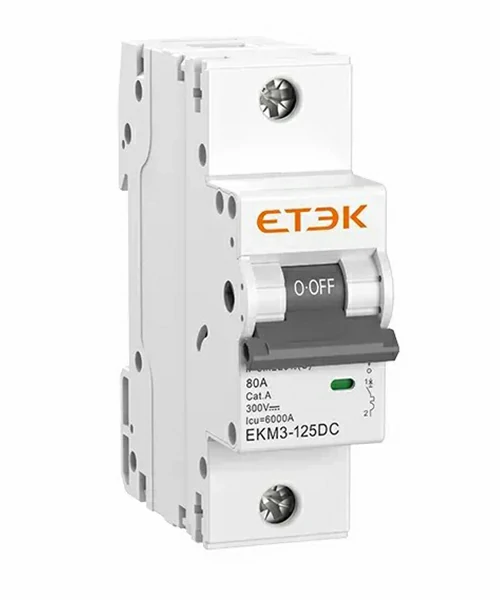
A proper DC circuit breaker is engineered specifically for these conditions. The magnetic blow-out, the arc chamber, the contact materials—everything is designed around the physics of DC arc extinction.
Summary
Arc extinction in a high-voltage DC circuit breaker isn‘t magic—it’s physics. Because DC current has no natural zero-crossing, the breaker must force the arc to extinguish by generating an arc voltage higher than the system voltage. Magnetic blow-out drives the arc into the arc chamber, where metal plates split and cool it until it can no longer sustain itself. The entire process happens in milliseconds, protecting your equipment and your people.
What to Take Away:
DC arcs have no natural zero-crossing—they must be forced to extinguish.
Magnetic blow-out uses permanent magnets to drive the arc into the chamber.Arc splitters divide the arc into multiple segments, raising arc voltage until interruption occurs.A high-voltage DC circuit breaker is purpose-built for DC—never substitute an AC breaker.
Have a Specific DC Protection Need?
Whether you‘re designing a utility-scale solar farm or upgrading a battery storage system, selecting the right DC circuit breaker is critical. Our team can help you evaluate voltage ratings, breaking capacities, and arc chamber designs for your specific application. Contact us to discuss your project requirements.
-1640.jpg)